Long before wedding sparklers lit wedding exits or crackled on the 4th of July, they served a different purpose. What started as primitive bamboo tubes eventually transformed into one of the world’s most beloved hand-held traditions. Pyrotechnics first emerged in ancient China around the 7th century AD during the Tang Dynasty. Early artisans discovered that filling hollow bamboo stalks with gunpowder created loud explosions and bright flashes. Over time, as pyrotechnics grew more refined, artisans realized that dipping bamboo sticks into a slurry of gunpowder produced a continuous shower of dazzling sparks without a sudden blast. This simple innovation marked the birth of the handheld sparkler, transforming early fireworks into a standard element of celebrations throughout Asia.
Today, we still use sparklers to celebrate and commemorate many of the holidays we observe. Obviously, the 4th of July comes to mind, but also New Year’s, Diwali, and many other holidays. Wedding sparklers have also become very popular, adding a special touch and an interactive feel to the event.
What is the Original History of Sparklers?
Knowing for sure who created the first handheld sparkler is nearly impossible. However, it is widely accepted that the inventor was an architect named Callinicos of Heliopolis. He lived in 670 AD and created a device called a “cheirosiphon“. While the cheirosiphon functioned more like a primitive Roman candle than a modern sparkler, it proved that handheld firework devices were possible. Over the centuries, trade along the Silk Road helped merge Byzantine engineering concepts with Chinese gunpowder formulas, laying the groundwork for personal fireworks.
The most transformative leap in sparkler history occurred during the mid-19th century in Germany. Faced with a shortage of bamboo, German makers began coating sturdy steel wire rods with a slurry of iron filings, sulfur, and gunpowder. This innovation yielded several key benefits:
- Mass production: Metal wire allowed factories to manufacture sparklers uniformly, cheaply, and efficiently.
- Increased safety: Wire handles eliminated the risk of bamboo splitting or catching fire mid-burn.
- Brighter effects: Incorporating iron filings produced the distinct golden “branching” sparks that define traditional wedding sparklers.
How the History of Sparklers is Being Shaped in Modern Times
Of course, the history of sparklers doesn’t end there. Every year, there are more and more varieties of sparklers that hit the market. There are new styles, shapes, colors, and more to constantly push the barriers of what we think is possible. There are sparklers for almost every occasion now, and there are several ways to use them that you never would dream of. Here is how they are being used in modern times.
4th of July
America’s connection with 4th of July pyrotechnics dates back to July 4, 1777, during the very first anniversary of the Declaration of Independence. By the early 20th century, handheld sparklers had firmly established themselves in backyards across the nation. Their accessibility, ease of use, and nostalgic charm make them the single most popular item on Independence Day and every summer in the United States every summer.
Weddings
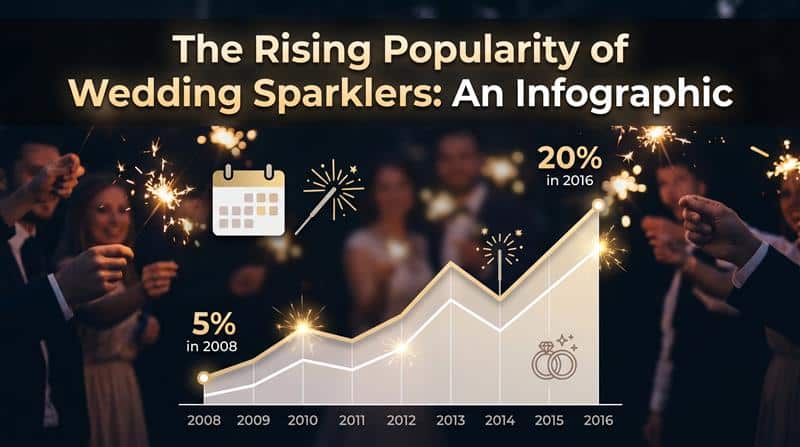
Though it’s a slightly newer tradition, using sparklers for weddings has rapidly grown in popularity. In fact, weddings are now the second most popular time to use them behind the 4th of July. Couples frequently coordinate sparkler exits at the end of the reception, creating an illuminated tunnel of light for exit photography. High-grade wedding sparklers, including romantic heart-shaped sparklers, feature steel wires specifically engineered to burn cleanly without obscuring photos in heavy smoke.
New Year’s Eve
New Year’s Eve is another traditional time to break out colorful sparklers and celebrate. At the stroke of midnight, people wear their funny hats and blow in their noisemakers. It’s also common to have a champagne toast and light sparklers. Though weddings have become more popular for using wedding sparklers, this tradition is much older.
Birthdays
Celebrating a birthday is usually much different than the way we celebrate other holidays or events. However, they are still a huge celebration that can benefit from using sparklers. Instead of using a regular version, it is more popular to use cake sparklers at a birthday party. You can either replace the traditional birthday candles entirely, or these can be an add-on.
Nightclubs, Bars, and Restaurants
Lastly, there has been a huge movement in the hospitality industry to include long-burning sparklers. Most commonly, a restaurant will use them to decorate a fancy dessert. Additionally, many bars use bottle sparklers to make their VIP services more appealing.
Looking Ahead
When viewed across the entirety of human history, modern wedding sparklers are a relatively recent innovation. From gunpowder-dipped bamboo in ancient China to 19th-century German steel wires, the sparkler has continuously evolved to become safer, brighter, and more reliable.
Today, that legacy of craft continues through reliable sellers like Wedding Day Sparklers, where couples can source high-quality sparklers that deliver brilliant photo-ready displays without the premium price tag. As manufacturing technologies continue to advance, lighting up life’s biggest moments will only get safer, brighter, and more memorable.
FAQs
Why do people put sparklers on champagne bottles?
People use sparklers on champagne bottles because they create a dramatic look and signal a celebration.
How long do bottle sparklers last?
Bottle sparklers are perfect for parties and can last from anywhere between 45 to 50 seconds without any interruptions.
What is the best length sparkler for a wedding?
The ideal length of a sparkler for a wedding depends completely on the exact moment you are using it. If you want something long-burning, then you can get 36 inch sparklers.
Are modern sparklers significantly safer than historical versions?
Yes, modern production replaces splattering bamboo cores with sturdy steel wires and engineered chemical formulas that burn at controlled temperatures.